
Legalize Plato
Texas A&M sends its goons in to attack the classics.

The Social Justice movement has been notorious for its intolerance to dissenting opinions, and has often reached high levels in university administrations. And of course such left-wing movements on race and gender have a long history of attacking “dead white males” – in contrast to those contemporary right-wingers who seek to “RETVRN“ to a premodern West, stylizing it with a V to indicate their classical sympathies. So when a university orders a professor to remove Plato from his philosophy syllabus, surely that must be a woke thing. Right?
Nope!
Texas A&M University ordered the removal of Plato because he was too woke.
Philosophy professor Martin Peterson was going to teach a reading from Plato’s Symposium in an ethics class, as normal philosophy professors all over the world do. But Peterson was told by his department chair that “You may mitigate your course content to remove the modules on race ideology and gender ideology, and the Plato readings that may include these.” This instruction was implementing a new and obfuscating university system policy that “No system academic course will advocate race or gender ideology, or topics related to sexual orientation or gender identity, unless the course and the relevant course materials are approved in advance by the member CEO.” If Peterson didn’t comply, he would be assigned to teach a different course.
This is bad, obviously. The brutish anti-intellectualism of Ronald Reagan’s proclamation that taxes shouldn’t be “subsidizing intellectual curiosity” goes much further here, to the outright thuggery of one of the Texas A&M regents proclaiming, in this context, that “Curriculum is created and approved based on the accepted body of knowledge needed for our students to be successful in their chosen profession… It is unacceptable for other material to be taught instead.” That’s a step well beyond Reagan: this regent is not just saying that taxes shouldn’t pay for genuine learning, but that it’s unacceptable for that learning to happen: universities should be job-training farms and nothing more. How far we are from the erudite intellectual conservatism of William F. Buckley and Roger Scruton, who must be spinning in their graves. So much for the RETVRN.
Serious intellectuals like Buckley and Scruton – and their counterparts on the left – know that ancient texts challenge us, open up another world beyond the one we take for granted, including saying things that we dislike or even that alarm us. They know that that’s valuable. They probably wouldn’t have liked the parts of Plato that were being taught, but I can’t imagine them demanding their removal.
So what wouldn’t they have liked? What exactly were the Texan university thugs objecting to? As far as I know, there wasn’t any further specification about what in Plato counts as “gender ideology” (or “race ideology”). But it isn’t hard to guess, given that the text in question was the Symposium. That text is one of the Western world’s most famous paeans to romantic or erotic love… and the love in question is between males.
It would be a bit anachronistic to say that Plato “was gay”. The concept of homosexual identity is a relatively modern one; the ancient Greeks didn’t divide people into hetero, homo, bi. Rather, as I understand it, it was customary for an older Greek man to take a teenage male romantic partner, acting as a mentor to him; today that aspect of the Greek custom is scandalous to both left and right. The man would also marry a woman, but that relationship was usually viewed as less romantic and more businesslike – in a way likely tied to a patriarchal aesthetic that prized male beauty above all.
All of which is to say that no matter where you stand on the contemporary political spectrum, there’s likely going to be something about sexuality in ancient Greece, and in Plato in particular, that shocks you. But that shock is part of how we learn. You certainly don’t need to endorse all aspects of ancient Greek sexuality; I’d be suspicious of anyone who did! But it does help open our minds to see how differently they did things – including the kind of sexual acts that we would now classify as gay.
But then, opening minds has itself been something openly frowned upon by Texas Republicans, for some time. The Texas Republican Party’s 2012 platform proclaimed its opposition to educational programs that “have the purpose of challenging the student’s fixed beliefs and undermining parental authority.” And if there’s anything that challenges fixed beliefs, it’s reading the classics and taking them seriously.
What nobody, left or right, should do is acquiesce to such a brutish, narrow-minded perspective – one that effectively advocates stupidity, a much tighter closing of the American mind than the kind that Allan Bloom had worried about. Don’t take the word of Texas A&M’s president, Tommy Williams, and his dishonest and cowardly denial that Plato was being forcibly removed from a course syllabus.
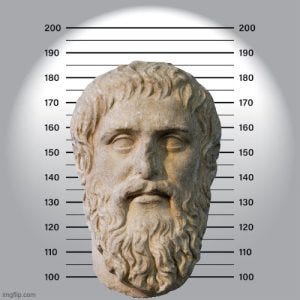
Sadly, as with so many awful things going on in the US right now, there’s not a whole lot that most of us can do about it. But I do appreciate UCSD philosopher Saba Bazargan’s attempt to raise awareness with T-shirts that proclaim “Legalize Plato”. (No, nobody’s making Plato illegal, but it works well as a slogan, and forcibly removing him from syllabi is bad enough.) I ordered one, and in keeping with my own queerness, was happy to find that I could get it in hot pink.
Agree with the sentiment, although the Texas treatment of Plato is relatively mild compared to what happened to Socrates.
Well said. I might add that Peterson decided to teach the course and as a substitute for the section that included Plato he designed a section on academic freedom that would include the university system policy as one of the readings. We need more little acts of resistance.